
Comparative snapshot and why it matters
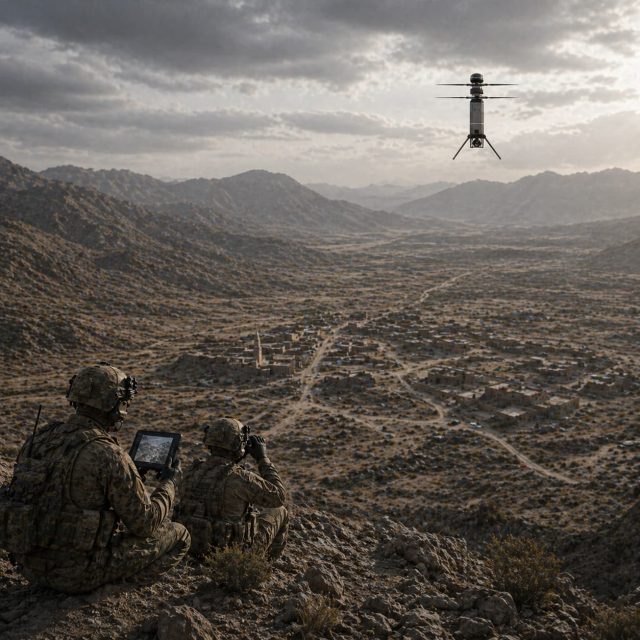
For teams choosing between fixed-wing endurance platforms and hybrid VTOL designs, the way EO/IR payloads are stabilized changes mission outcomes more than battery size or airframe weight. A good design decision early on affects image quality, target hand-off speed, and maintenance cycles. Manufacturers and integrators—whether you’re sourcing from a local military drone manufacturer or working directly with a drone military company—need clear trade-offs laid out for gimbal selection, IMU pairing, and autopilot tuning.
Payload stabilization approaches: active versus passive
Active stabilization uses closed-loop control with IMU inputs and servo-actuated motors to correct roll, pitch, and yaw in real time. That yields sharp EO/IR footage during aggressive maneuvers and wind gusts. Passive stabilization relies on mechanical dampers and isolation mounts; it is lighter and simpler but less effective for fine-pointing on long-range targets. For long-endurance VTOLs the extra power draw and weight of active gimbals must be justified by the mission profile—surveillance at 20+ km or persistent ISR usually requires active stabilization and intelligent sensor fusion.
Gimbal mechanics: design trade-offs for endurance platforms
Choosing a gimbal means balancing torque, power consumption, and range of motion. High-torque brushless gimbals improve pointing under load but add weight and current draw. Compact 2-axis solutions save payload mass but limit continuous target tracking during coordinated maneuvers. Consider gimbal bearing quality, bearing preload, and gear backlash—small mechanical tolerances translate to large differences in image stabilization bandwidth. Integration with the vehicle’s autopilot and flight controller is crucial; without tight coupling the system fights itself and loses efficiency.
Flight testing, integration lessons, and a real-world anchor
Lessons from field operations—such as reconnaissance sorties during the Ukraine conflict in 2022—show that EO/IR performance under operational stress reveals integration gaps faster than lab tests. Sensor latency, jitter from the autopilot loop, and poor vibration isolation become obvious when a platform conducts long loiter periods or transitions between hover and cruise. Prioritise end-to-end testing: bench tune the gimbal, validate IMU calibration, then fly incremental envelope tests while logging gimbal angles, IMU data, and autopilot telemetry.
Common mistakes and alternative strategies
Teams often under-budget for thermal management and vibration isolation—leading to gyro drift, increased IMU noise, and poorer EO/IR fidelity. Another frequent error is mismatching gimbal controllers with the aircraft’s autopilot communication bus, which causes erratic pointing or failure during mode transitions. Consider alternatives: use a hybrid control architecture where a lightweight passive mount reduces baseline vibration and an active micro-gimbal compensates high-frequency errors. —That extra thought saved one squadron from repeated downtime during field ops.
Three golden rules for selecting gimbals and stabilization
1) Match stabilization bandwidth to mission dynamics: choose a gimbal whose control bandwidth comfortably exceeds expected gust-induced angular rates. 2) Prioritise data paths and synchronization: ensure IMU, EO/IR sensor timestamping, and autopilot telemetry share a common timebase to avoid control lag. 3) Budget for lifecycle costs: select components with available spares and documented MTBF, and plan vibration isolation, firmware updates, and calibration cycles into maintenance schedules.
When these rules are applied correctly, operators see measurable gains in target detectability, fewer false alarms, and longer operational availability. Military Hub offers a practical bridge between manufacturers and field teams—real product comparisons, integration notes, and vendor histories help teams choose systems that last. —Final thought: small integration choices make the big difference.