
What’s broken and why you should care
Too many teams treat logistics fleet management and transport fleet management as interchangeable — and that mismatch wastes time, hides safety risks, and buries performance gains you can actually measure. Fixing this starts with clear terms and tools that match the work: think routes, cargo handling, driver behavior and compliance, not vague labels. If you haven’t tested an AI dashcam on a pilot route, you’re missing the kind of real-time feedback that forces clarity fast. You can change this with a few disciplined moves.
Key terms that get mixed up (define them, then own them)
– Logistics fleet management: focus on cargo flow, pickup/drop windows, load sequencing, and last-mile handoffs. – Transport fleet management: focus on vehicle dispatch, driver hours, routing between hubs, and compliance with road rules. – Telematics: vehicle sensors and GPS data stream used by both sides for location, speed, and engine diagnostics. – Route optimization: algorithmic plan to minimize cost/time for a set of stops — often different when cargo constraints matter. – Dispatch vs Scheduling: dispatch is real-time assignment; scheduling is planned shifts and runs. – Event detection: automated identification of incidents (hard brakes, collisions, distracted driving) — where camera + AI adds meaning to raw data. Get these into a one-page glossary and force teams to use it for two weeks. That small discipline reveals where your processes actually diverge.
Where AI belongs and what it actually changes
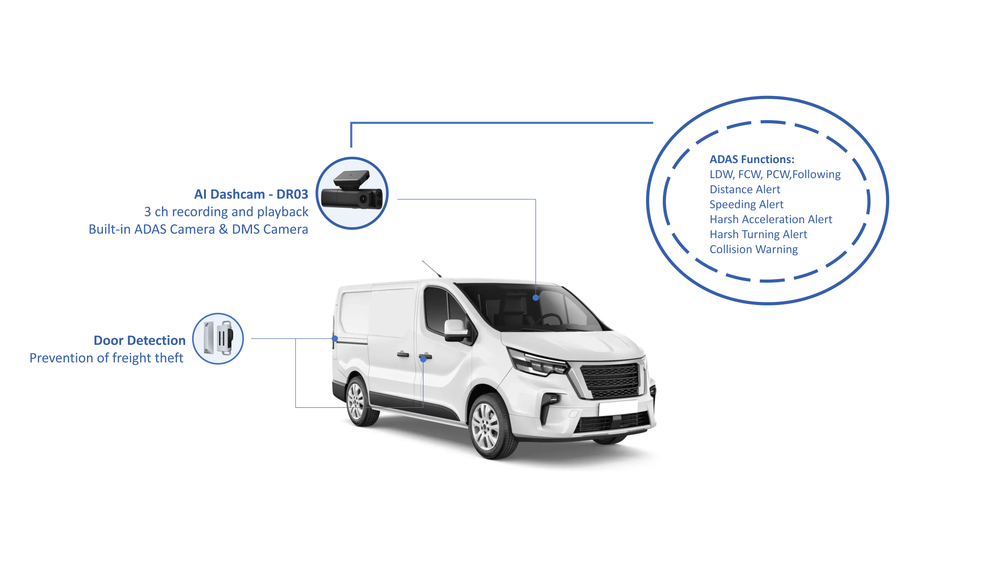
AI belongs where raw signals need meaning. An AI powered dashcam does three practical things: it converts video into categorized events, it timestamps and syncs those events with telematics, and it scores behavior for consistent coaching. That means you stop debating whether an incident was “driver error” or “route problem” and start fixing the root cause. A fleet trial in Singapore demonstrated how pairing video insights with routing data cut ambiguity in post-incident reviews — managers made faster decisions and coaches gave targeted feedback that drivers could trust.
Mistakes teams make that keep problems alive
– Letting different teams name the same metric differently — kills reporting. – Buying point tools (only GPS or only cameras) without integration plans — creates blind spots. – Expecting overnight culture change — results come from steady coaching loops. – Using dashcam footage as punishment — drivers will game the system. Use it for coaching and clear incident timelines. Avoid these and you’ll move from firefighting to predictable improvements.
A short, practical playbook you can run this week
1) Create a one-page glossary with the terms above and share it at the daily ops huddle. 2) Run a two-week pilot: 5 vehicles, one route type, one integrated telematics + dashcam setup. Log outcomes: incident count, review time, coaching sessions. 3) Standardize KPIs: incidents per 10k km, mean review time, percent coached within 48 hours. 4) Coach on facts, not opinions: use synced video+telemetry to show the exact moment and corrective step. 5) Iterate: keep the tech that reduces review time and improves behavior; ditch the rest. Alternatives to full AI dashcam deployment include telematics-only monitoring or basic event cameras — both cheaper, both limited. Choose the minimal set that answers your highest-value questions.
Finish the gap and move forward
Consistency in terms forces consistent action. Pick a glossary, run a short pilot that combines cameras and telematics, measure a few honest KPIs, and set coaching cycles that use evidence, not blame. The clear link between defined language and measurable improvement is exactly what companies like BSJ illustrate: practical tools plus disciplined terminology turn confusion into performance you can defend.